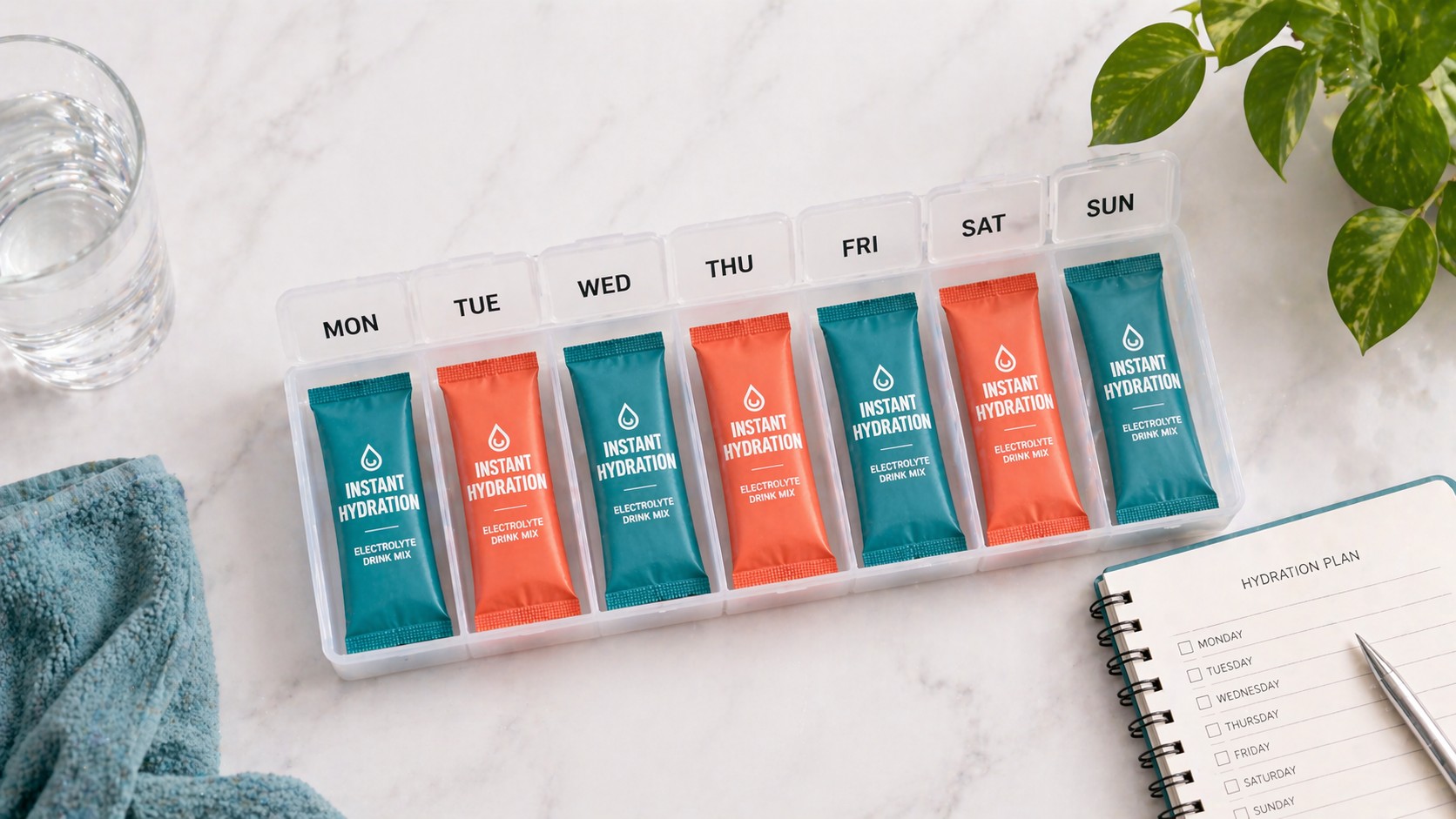
Not medical advice. This article is for educational and informational purposes only and is not a substitute for advice from a licensed healthcare provider. Consult a doctor or registered dietitian before making changes to your hydration, sodium intake, or supplement use — especially if you have a health condition, are pregnant or breastfeeding, or are giving electrolyte products to a child.
Table Of Content
- The Short Answer (By User Type)
- Sodium Math — How Each Packet Adds Up
- What this means
- FDA and Health Organization Sodium Guidelines
- When More Packets Are OK
- Endurance athletes
- Hot weather
- Illness recovery
- Keto or fasting
- When to Drink Fewer Packets
- Hypertension (high blood pressure)
- Kidney disease (CKD)
- Heart failure or fluid retention
- Certain medications
- Signs You’ve Had Too Much
- Pregnancy and Breastfeeding Guidance
- Kids and Teens Guidance
- Practical Daily Routine Examples
- Daily desk worker (low activity, healthy)
- Gym-goer (4x per week, moderate)
- Endurance athlete (running, cycling, triathlon)
- Hot-weather outdoor worker
- Keto or fasting
- Frequently Asked Questions
- Is it safe to drink Instant Hydration every day?
- Can you drink more than one Instant Hydration per day?
- What happens if you drink too many electrolytes?
- How much sodium per day is safe?
- Can you drink Instant Hydration without working out?
- Is Instant Hydration safe for pregnancy?
- Is it safe for kids?
- Related
- External references
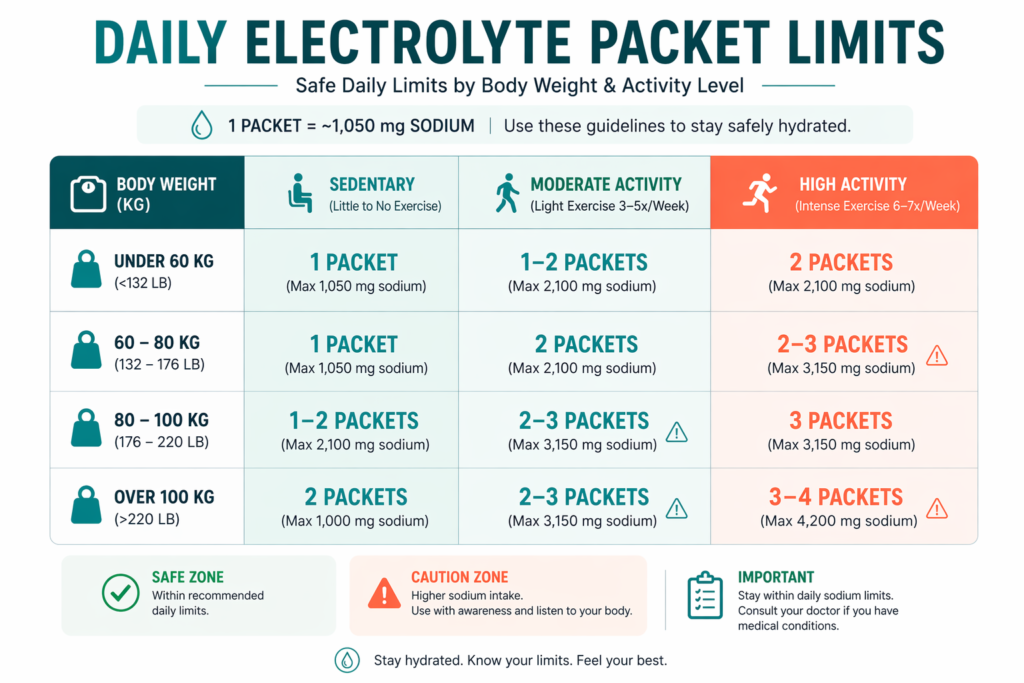
Quick answer: 1 to 2 packets per day is safe for most healthy adults. Each packet contains 500–750mg of sodium, and the FDA daily limit is 2,300mg. Two packets at 500mg each gives you 1,000mg — about 43% of your daily allowance — leaving plenty of room for sodium from food. Endurance athletes in hot weather can safely go up to 3–4 per day. People on low-sodium diets, with hypertension, kidney disease, or certain medications should consult a doctor and likely stay under 1 per day.
The Short Answer (By User Type)
| User type | Safe range | Notes |
|---|---|---|
| Healthy adult sedentary | 1 packet | Standard daily hydration top-up |
| Healthy adult active (gym 3-5x/wk) | 1-2 packets | Second packet on gym days |
| Endurance athlete | 2-4 packets | Space throughout training |
| Someone recovering from illness | 2-3 packets (acute) | Return to 1 when recovered |
| Hot weather / heavy sweat | 2-3 packets | Spread across the day |
| Low-sodium diet / hypertension | 0-1 packet | Consult doctor |
| Kidney disease (CKD) | Consult doctor before use | |
| Pregnant (approved by OB) | 1 packet | Monitor BP and preeclampsia risk |
| Kids under 4 | Not recommended | Use Pedialyte instead |
| Kids 4-12 | Half packet diluted if needed | Only during illness or heat |
Sodium Math — How Each Packet Adds Up
The sodium content is the primary thing that limits how many packets you can have:
| Quantity | Sodium from packets | % FDA daily limit (2,300mg) |
|---|---|---|
| 1 packet (standard) | 500mg | 22% |
| 1 Cotton Candy packet | 750mg | 33% |
| 2 packets (standard) | 1,000mg | 43% |
| 2 packets + 1 Cotton Candy | 1,750mg | 76% |
| 3 packets (standard) | 1,500mg | 65% |
| 4 packets (standard) | 2,000mg | 87% |
What this means
The average American already gets 3,400mg of sodium per day from food — well above the FDA limit of 2,300mg. If you’re eating a typical American diet and you add 3+ Instant Hydration packets, you’re at risk of sustained sodium overload. If you’re on a low-sodium or whole-foods diet (1,500–2,000mg from food), you have more room.
Simple rule: packet sodium + food sodium < 2,500mg daily for most adults. If you track rough food sodium, you’ll know how much room you have for packets.
FDA and Health Organization Sodium Guidelines
Recommended daily sodium limits:
- FDA: 2,300mg maximum (about 1 teaspoon of salt)
- American Heart Association: 1,500mg ideal (for optimal blood pressure)
- WHO: 2,000mg maximum
Athletes, hot-climate workers, and people on ketogenic diets can exceed these limits safely because they lose more sodium through sweat and urine. Sedentary people with high blood pressure should aim lower.
When More Packets Are OK
Endurance athletes
If you’re running, cycling, or doing intense training for 2+ hours at a stretch, especially in heat, your body loses 500–1500mg of sodium per hour of intense sweat. Replacing it requires more than the 500mg in a single packet. 2–3 packets during and after a long session is appropriate.
Hot weather
In sustained heat (>85°F working or outdoor activity), even non-athletes need more sodium. 2–3 packets through the day is reasonable.
Illness recovery
When you’ve been vomiting or have had diarrhea, acute electrolyte depletion is real. 2–3 packets over the first 24 hours is medically reasonable. Return to 1 per day once the illness resolves. (Note: for severe illness, medical-grade ORS like Pedialyte or Drip Drop may be more appropriate — see Instant Hydration vs Pedialyte.)
Keto or fasting
Ketogenic diets and fasting both increase sodium excretion. Keto users often report benefits from 2 packets daily. If you’re on a strict keto protocol, LMNT (1000mg sodium per serving) may be a better tool — see Instant Hydration vs LMNT.
When to Drink Fewer Packets
Hypertension (high blood pressure)
Any diagnosed hypertension should lower you to 0–1 packet per day, and only with your doctor’s knowledge. Sodium and blood pressure are directly linked. The AHA’s ideal 1,500mg ceiling doesn’t leave much room for concentrated electrolyte drinks.
Kidney disease (CKD)
Your kidneys regulate sodium and potassium. With impaired kidney function, concentrated electrolyte drinks can create dangerous electrolyte imbalances. Consult your nephrologist before any regular use.
Heart failure or fluid retention
Sodium causes water retention. If you have heart failure, edema, or any condition where fluid retention matters, sharply limit electrolyte drinks. Consult your cardiologist.
Certain medications
- ACE inhibitors or ARBs (lisinopril, losartan) — raise potassium; added potassium from electrolyte drinks can push you high
- Potassium-sparing diuretics (spironolactone) — same concern
- Lithium — sodium changes affect lithium levels
Check with your prescriber before regular Instant Hydration use.
Signs You’ve Had Too Much
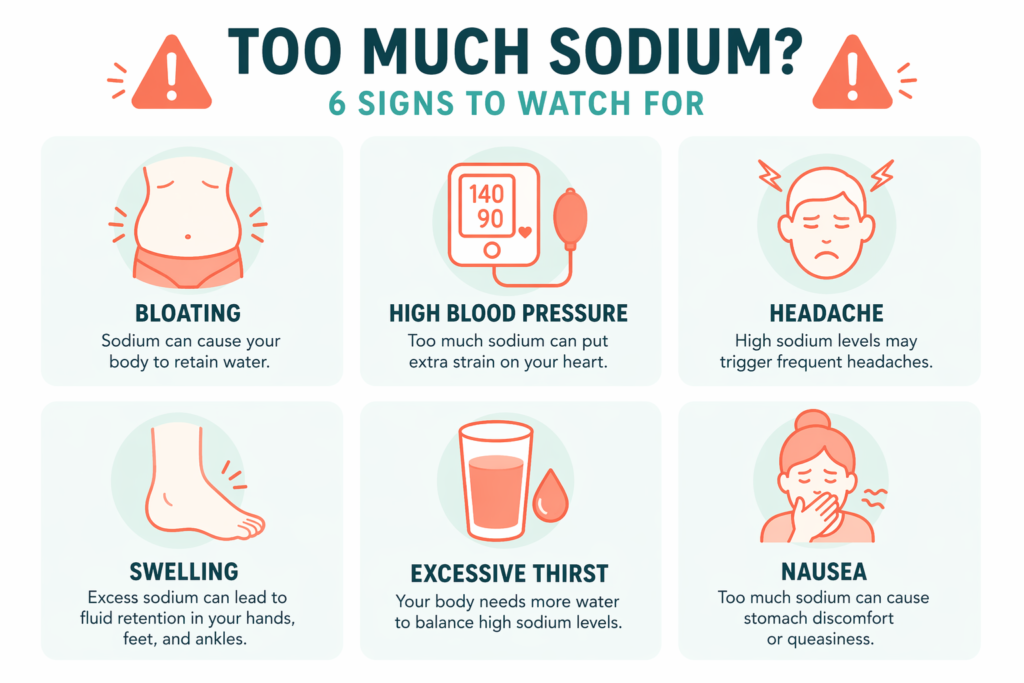
Watch for these if you’ve been drinking more than 2 packets per day:
- Water retention / puffy ankles or fingers
- Persistent thirst despite drinking fluids
- Mild headache
- Elevated blood pressure (if you track it)
- Unusual sodium taste or saltiness sensation on the tongue
These resolve quickly when you cut back. Severe symptoms (confusion, muscle cramps, irregular heartbeat) are unlikely at typical doses but require immediate medical attention.
Pregnancy and Breastfeeding Guidance
Pregnancy: 1 packet per day, with OB approval, is a reasonable starting point. Sodium during pregnancy interacts with preeclampsia risk. If your OB has flagged preeclampsia concerns, skip electrolyte drinks or use only under their direction.
Breastfeeding: Generally safer than pregnancy — hydration matters significantly for milk supply. 1–2 packets per day is commonly tolerated. Monitor your own blood pressure if you have any history of hypertension.
Kids and Teens Guidance
Under 4: Do not give Instant Hydration. Use Pedialyte, which is pediatrically formulated. See Is Liquid IV safe for kids? for the full pediatric electrolyte discussion.
Ages 4–12: Only during illness, intense athletic activity, or hot weather. Start with half a packet in 16+ oz of water. Do not give daily as a wellness supplement — kids generally don’t need this.
Ages 13+: Can be used like an adult with appropriate scaling to body weight and activity. Teen athletes in hot sports (football, soccer, tennis) often benefit. 1–2 packets daily is reasonable.
Practical Daily Routine Examples
Daily desk worker (low activity, healthy)
- 1 packet in morning water bottle
- Plain water throughout the day
- Food provides the rest of sodium needs
Gym-goer (4x per week, moderate)
- 1 packet in morning water bottle on non-gym days
- 1 packet post-gym + 1 packet morning on gym days (= 2 on gym days)
Endurance athlete (running, cycling, triathlon)
- 1 packet morning
- 1 packet during workout (for sessions 60+ minutes)
- 1 packet post-workout recovery
- = 3 packets on heavy training days
Hot-weather outdoor worker
- 2 packets spread across the workday
- Additional plain water
- = 2–3 packets, always paired with plenty of water
Keto or fasting
- 1 packet morning
- 1 packet mid-afternoon
- Additional salt from food if needed
Frequently Asked Questions
Is it safe to drink Instant Hydration every day?
Yes, for most healthy adults at 1–2 packets per day. Daily use provides net hydration and mild electrolyte benefits. People with kidney disease, hypertension, or certain medications should consult a doctor first.
Can you drink more than one Instant Hydration per day?
Yes. 2 packets per day is safe for most adults. Athletes and hot-weather users can safely go to 3–4 on high-need days. Avoid exceeding 4 regularly.
What happens if you drink too many electrolytes?
Short-term: water retention, persistent thirst, mild headache, slight blood pressure increase. These resolve when you cut back. Severe overdose (very unlikely at consumer doses) could cause hypernatremia — confusion, irregular heartbeat — and requires medical attention.
How much sodium per day is safe?
FDA: 2,300mg maximum. AHA: 1,500mg ideal. Athletes and hot-climate workers can exceed these safely. Add up food sodium + packet sodium to stay aware.
Can you drink Instant Hydration without working out?
Yes. Many daily users are sedentary and use 1 packet per day for general hydration benefits. The moderate sodium content doesn’t require athletic sodium loss to justify it.
Is Instant Hydration safe for pregnancy?
Generally, yes, with OB approval, typically at 1 packet per day. Sodium during pregnancy has preeclampsia implications, so OB consultation matters. See also our Instant Hydration legitimacy investigation for pregnancy details.
Is it safe for kids?
Under 4: No — use Pedialyte. 4–12: Only during illness, heat, or athletics, starting with half a packet. 13+: Adult scaling. See Is Liquid IV safe for kids?.
Related
- Instant Hydration reviews 2026
- Is Instant Hydration legit? 30-day test
- How much sodium is in Liquid IV?
- Is Liquid IV safe for kids?
- Instant Hydration vs Pedialyte
External references
- FDA sodium guidelines
- American Heart Association sodium recommendations
- NIH Office of Dietary Supplements — potassium
Last updated: April 2026. Reviewed by our editorial team. This article is informational and does not substitute medical advice.