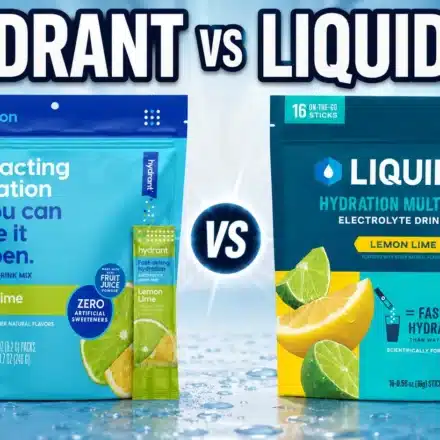
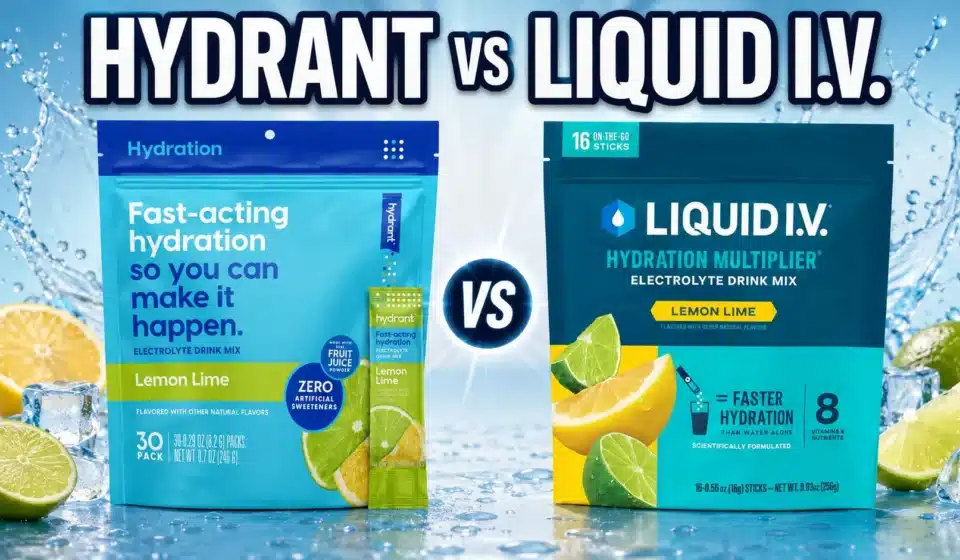
If you are comparing Hydrant vs Liquid IV, the most important difference is not the packaging or the number of flavors. It is the strength of the formula.
Table Of Content
- Quick Answer: Hydrant or Liquid IV?
- Hydrant vs Liquid IV at a Glance
- How We Compared Hydrant and Liquid IV
- What Is Hydrant?
- Hydrant pros
- Hydrant cons
- What Is Liquid I.V.?
- Liquid I.V. pros
- Liquid I.V. cons
- Hydrant vs Liquid IV Ingredients and Electrolytes
- Sodium: Liquid I.V. has almost twice as much
- Potassium: Liquid I.V. wins
- Magnesium and zinc: Hydrant wins
- Sugar and calories: Hydrant is much lighter
- Vitamins: Liquid I.V. wins, with one caveat
- Does One Hydrate Faster?
- Hydrant vs Liquid IV Taste and Flavor Options
- Hydrant taste
- Liquid I.V. taste
- Hydrant vs Liquid IV Price
- Availability, Subscriptions and Returns
- Which One Is Better for Different Situations?
- Can You Drink Hydrant or Liquid IV Every Day?
- Final Verdict: Is Hydrant Better Than Liquid IV?
- Frequently Asked Questions
- Is Hydrant the same as Liquid IV?
- Which has more electrolytes, Hydrant or Liquid IV?
- Which has less sugar, Hydrant or Liquid IV?
- Does Hydrant contain stevia?
- Is Hydrant better than Liquid IV for workouts?
- Which hydrates faster, Hydrant or Liquid IV?
- Is Hydrant or Liquid IV better for a hangover?
- Can I drink Hydrant or Liquid IV when sick?
- Is Hydrant or Liquid IV better during pregnancy?
- Is Liquid IV’s 500 mg of sodium too much?
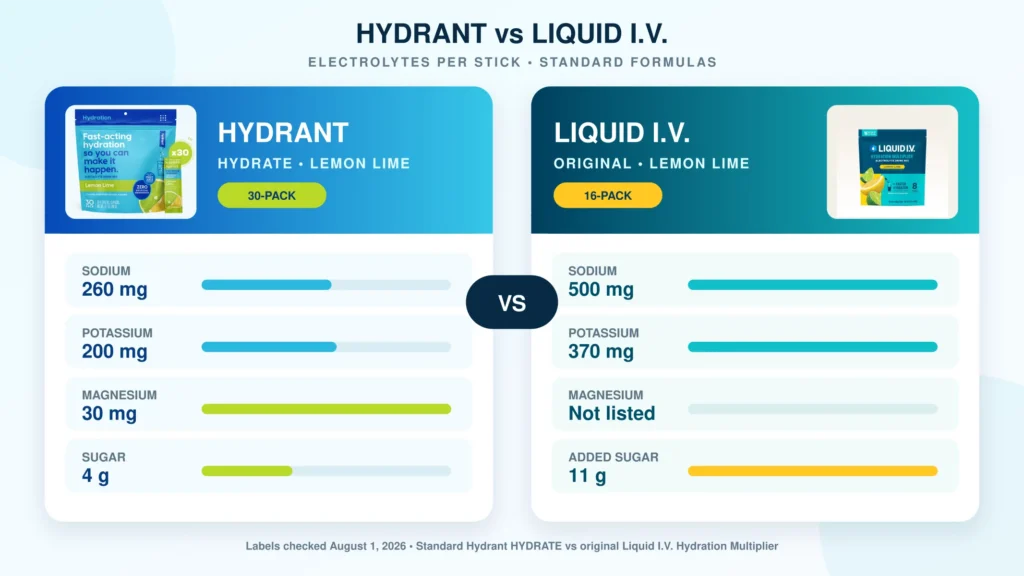
Hydrant is the lighter everyday option. A standard Hydrant HYDRATE stick contains 260 mg of sodium, 200 mg of potassium, 30 mg of magnesium and 4 g of sugar. Original Liquid I.V. Hydration Multiplier contains 500 mg of sodium, 370 mg of potassium and 11 g of added sugar, but no meaningful amount of magnesium is listed on its Nutrition Facts panel.
That makes Hydrant easier to justify for travel, ordinary hot days and light-to-moderate exercise. Liquid I.V. is more useful when you have lost a meaningful amount of fluid and sodium through a long, sweaty workout or extended heat exposure.
However, neither product needs to replace plain water during an ordinary day.
Quick Answer: Hydrant or Liquid IV?
Hydrant is our overall pick for everyday use. It has less than half the sugar of original Liquid I.V., roughly half the sodium, and includes magnesium and zinc. Its standard formula also uses real fruit juice powder and avoids stevia, sucralose and synthetic dyes.
Liquid I.V. is the better pick for heavy sweating and convenience. It supplies nearly twice as much sodium and potassium, includes vitamin C and several B vitamins, has a much larger flavor selection and is sold through many major U.S. retailers.
Choose Hydrant if you want:
- A lighter daily electrolyte powder
- Only 4 g of sugar per serving
- Magnesium in your hydration mix
- A less sweet, more fruit-forward flavor profile
- Lower sodium than original Liquid I.V.
Choose Liquid I.V. if you want:
- More sodium and potassium per packet
- Support after long, hot or high-sweat workouts
- A sweeter and stronger flavor
- Added vitamin C and B vitamins
- More flavors and easier in-store availability
For most healthy adults doing normal daily activities, water and regular meals are usually enough. CDC workplace heat guidance indicates that water is generally sufficient during moderate activity in heat lasting under two hours, while balanced electrolyte drinks become more useful when sweating continues for several hours.
Hydrant vs Liquid IV at a Glance
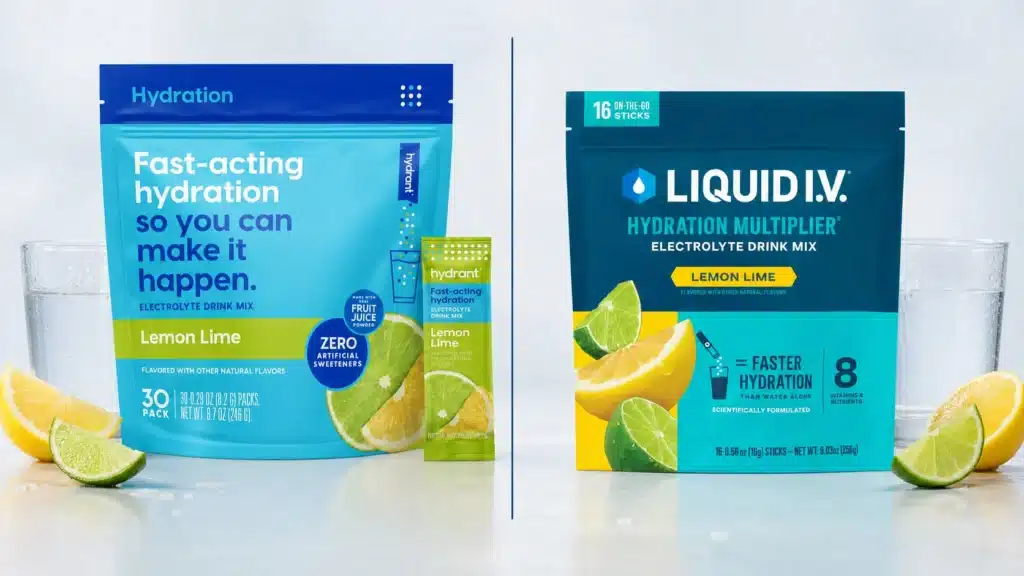
This comparison covers standard Hydrant HYDRATE stick packs and original Liquid I.V. Hydration Multiplier. It does not use the brands’ Energy, Immunity, Sleep, Kids or Sugar-Free formulas, which have different labels.
| Feature | Hydrant HYDRATE | Liquid I.V. Hydration Multiplier | Winner |
|---|---|---|---|
| Sodium | 260 mg | 500 mg | Depends on sweat loss |
| Potassium | 200 mg | 370 mg | Liquid I.V. |
| Magnesium | 30 mg | Not listed | Hydrant |
| Zinc | 2 mg | Not in standard formula | Hydrant |
| Sugar | 4 g | 11 g added sugar | Hydrant |
| Calories | About 20–25, depending on flavor | 45 | Hydrant |
| Main sweeteners | Cane sugar + monk fruit | Cane sugar/dextrose + stevia | Preference |
| Vitamin extras | Zinc; no large vitamin blend | Vitamin C, B3, B5, B6 and B12 | Liquid I.V. |
| Standard stick flavors shown | 3 + variety pack | 18 + variety pack | Liquid I.V. |
| Water per stick | 8–16 fl oz | 16 fl oz | — |
| One-time direct price | $44.99 for 30; $1.50 each | $24.99 for 16; $1.56 each | Hydrant by serving |
| Subscription price | $35.99 for 30; $1.20 each | $17.49 for 16; $1.09 each | Liquid I.V. |
| Best for | Daily use and moderate activity | Heavy sweating and broad availability | Depends on use |
Label details and prices were checked on August 1, 2026. Formulas, flavors, promotions and prices can change. Always confirm the package you are buying.
How We Compared Hydrant and Liquid IV
This Hydrant vs Liquid IV review is based on:
- Current U.S. Nutrition Facts and ingredient information
- Prices displayed on both official websites
- Product variety and buying options
- Public-health guidance on water, sodium and exercise hydration
- The practical needs of casual users versus heavy sweaters
We did not conduct a laboratory analysis or a sponsored clinical trial, and we are not presenting brand-site testimonials as medical evidence. Taste observations below are based on the formulas and expected flavor intensity rather than a made-up blind test.
You can also see how Liquid I.V. compares with other popular formulas in our Instant Hydration vs LMNT vs Liquid IV comparison and our broader guide to the best electrolyte drinks for quick hydration.
What Is Hydrant?
Hydrant HYDRATE is a powdered electrolyte mix sold in individual stick packs and selected bulk formats. Its standard formula is positioned as a lighter, cleaner-tasting alternative to high-sodium or heavily sweetened hydration powders.
One standard stick provides approximately:
- 260 mg sodium
- 200 mg potassium
- 30 mg magnesium
- 2 mg zinc
- 4 g cane sugar
- About 20–25 calories, depending on flavor
The current standard-flavor ingredient information includes cane sugar, fruit juice powders and extracts, sodium citrate, potassium citrate, magnesium gluconate, zinc gluconate, citric acid, malic acid, natural flavors, monk fruit, and fruit- or plant-derived colors. Exact ingredients vary by flavor.
Hydrant pros
- Less sugar and fewer calories than original Liquid I.V.
- Moderate sodium for a daily hydration packet
- Includes potassium, magnesium and zinc
- Standard product page states no stevia, sucralose or synthetic dyes
- Real fruit juice powder contributes to flavor
- 90-day money-back guarantee displayed on the official site
Hydrant cons
- Less sodium and potassium for heavy sweaters
- Far fewer standard stick flavors
- Smaller retail footprint than Liquid I.V.
- Subscription is not the cheapest regular per-stick option
- People who need substantial carbohydrate during endurance exercise will need another fuel source
What Is Liquid I.V.?
Liquid I.V. Hydration Multiplier is one of the most widely distributed electrolyte powders in the United States. The original formula combines sodium, potassium, glucose, vitamin C and B vitamins in single-serving packets designed to mix with 16 ounces of water.
One Lemon Lime stick provides:
- 500 mg sodium
- 370 mg potassium
- 11 g total and added sugar
- 45 calories
- Vitamin C
- Vitamins B3, B5, B6 and B12
Its ingredient list includes cane sugar, dextrose, citric acid, salt, potassium citrate, sodium citrate, dipotassium phosphate, silicon dioxide, stevia leaf extract, natural flavors and added vitamins. Ingredients can differ slightly by flavor or product line.
Liquid I.V. pros
- Nearly twice the sodium and potassium found in Hydrant
- Better suited to meaningful sweat and electrolyte loss
- Glucose supplies quick carbohydrate as well as sweetness
- Added vitamin C and four B vitamins
- Large original and sugar-free flavor ranges
- Available at major retailers including Costco, CVS, Kroger, Target, Walgreens, Walmart and Whole Foods
- Smaller direct-order box lowers the upfront cost
Liquid I.V. cons
- 11 g of added sugar per original packet
- 500 mg sodium may be unnecessary for casual sipping
- No meaningful magnesium listed in the original formula
- Sweeter taste may be too strong for some users
- Contains stevia, natural flavors and silicon dioxide
- Large vitamin percentages do not automatically create an energy boost
Hydrant vs Liquid IV Ingredients and Electrolytes
Sodium: Liquid I.V. has almost twice as much
Sodium is the most important electrolyte to consider after heavy sweating because sweat losses can be substantial. Original Liquid I.V. contains 500 mg per stick, compared with 260 mg in Hydrant.
The FDA Daily Value for sodium is less than 2,300 mg. One Liquid I.V. packet therefore supplies about 22% of that benchmark, while Hydrant supplies roughly 11%.
More sodium is not automatically better.
- For an ordinary day, short workout or light sweat loss, Hydrant’s 260 mg is usually the more proportionate formula.
- For a long run, hard training session, outdoor work or several hours of sweating, Liquid I.V.’s 500 mg may replace losses more effectively.
- For someone following a clinician-prescribed low-sodium diet, neither product should be treated as automatically suitable.
Sodium winner: Hydrant for daily use; Liquid I.V. for heavier sweat loss.
Potassium: Liquid I.V. wins
Liquid I.V. provides 370 mg of potassium, while Hydrant provides 200 mg.
Potassium supports fluid balance, normal nerve signaling and muscle function. Liquid I.V.’s higher amount is a meaningful advantage when the goal is stronger electrolyte replacement.
Hydrant still clears the 200 mg mark and is not merely flavored salt water, but Liquid I.V. delivers 85% more potassium per serving.
Potassium winner: Liquid I.V.
Magnesium and zinc: Hydrant wins
Hydrant provides 30 mg of magnesium and 2 mg of zinc. Standard Liquid I.V. does not list a meaningful amount of magnesium or zinc on its current Nutrition Facts panel.
Thirty milligrams of magnesium is modest and should not be marketed as a treatment for cramps or deficiency. It does, however, make Hydrant’s mineral profile broader.
Liquid I.V. focuses its formula on sodium, potassium, glucose and vitamins instead.
Mineral variety winner: Hydrant.
Sugar and calories: Hydrant is much lighter
Standard Hydrant contains 4 g of cane sugar and approximately 20–25 calories. Original Liquid I.V. contains 11 g of added sugar and 45 calories.
Liquid I.V.’s sugar is functional as well as flavorful. Glucose participates in sodium-glucose cotransport in the small intestine and also supplies quick carbohydrate during or after strenuous activity. The problem is context: a useful feature during prolonged exercise can be unnecessary during a desk-bound day.
The FDA lists 50 g as the Daily Value for added sugars, based on a 2,000-calorie diet. One original Liquid I.V. packet supplies 11 g, or 22% of that Daily Value. Hydrant’s 4 g is easier to fit into a lower-sugar routine.
Both brands also sell zero-sugar products, but those are separate formulas and should be compared on their own labels.
Sugar and calorie winner: Hydrant.
Vitamins: Liquid I.V. wins, with one caveat
Original Liquid I.V. includes vitamin C plus vitamins B3, B5, B6 and B12. Hydrant’s standard formula is much simpler and provides zinc rather than a large vitamin blend.
Liquid I.V. therefore wins the label comparison for added vitamins. However, very high percentages of water-soluble B vitamins should not be confused with caffeine or an instant performance boost. People who already use a multivitamin may not need another fortified product every day.
Vitamin winner: Liquid I.V.
Does One Hydrate Faster?
Both brands build their marketing around oral hydration science. Sodium and glucose can be absorbed together in the small intestine, and water follows. That mechanism is well established and is central to the World Health Organization’s oral rehydration salt formula.
That does not prove that every commercial electrolyte packet hydrates exactly three times faster than water, nor does it prove that Hydrant or Liquid IV is faster than the other in every person and situation.
There is no public, independent head-to-head clinical trial of these two finished products that justifies naming a universal speed winner. Liquid I.V. provides more sodium, potassium and glucose, so it is the more aggressive replacement formula. Hydrant supplies a smaller amount of glucose and electrolytes, which may be enough when losses are modest.
It is also important not to confuse either drink mix with an intravenous medical treatment. If someone has severe dehydration, confusion, fainting, very low urine output, persistent vomiting or serious diarrhea, a wellness powder should not delay medical care.
Hydrant vs Liquid IV Taste and Flavor Options
Taste is subjective, but the formulas point to two distinctly different experiences.
Hydrant taste
Hydrant uses 4 g of sugar, monk fruit and real fruit juice powder in its standard range. The likely result is a lighter, less candy-like drink with a mild tart or salty edge.
Standard stick options displayed at the time of review were:
- Blood Orange
- Lemon Lime
- Fruit Punch
- Variety Pack
Hydrant also listed separate zero-sugar stick flavors and several bulk-powder choices.
Liquid I.V. taste
Liquid I.V. combines 11 g of sugar with stevia, so it is typically the sweeter and more concentrated-tasting option. People who enjoy a strong sports-drink flavor may prefer it. Those who dislike stevia or very sweet drinks may need to dilute one packet into more than 16 ounces of water.
The official site displayed 18 individual original Hydration Multiplier flavors at the time of review, including Lemon Lime, Strawberry, Watermelon, Tropical Punch, Mango, Guava, Piña Colada, Pear and Cotton Candy.
Flavor-variety winner: Liquid I.V.
Lighter-taste winner: Hydrant.
Hydrant vs Liquid IV Price
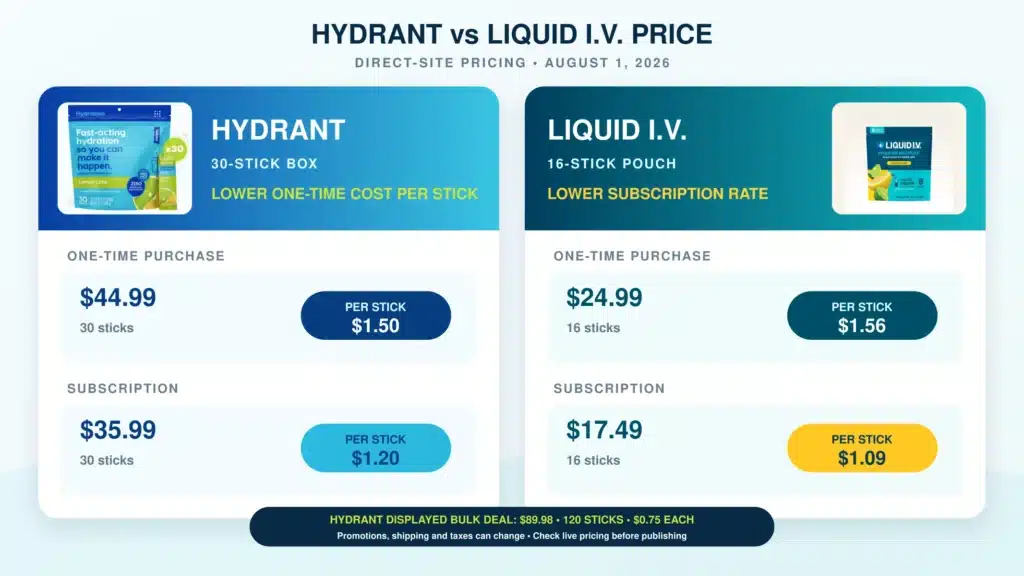
Direct-site pricing checked on August 1, 2026 was as follows:
| Purchase option | Hydrant | Liquid I.V. |
| One-time box | $44.99 for 30 sticks | $24.99 for 16 sticks |
| One-time cost per stick | $1.50 | $1.56 |
| Subscription box | $35.99 for 30 sticks | $17.49 for 16 sticks |
| Subscription cost per stick | $1.20 | $1.09 |
| Best displayed bulk promotion | $89.98 for 120 sticks; $0.75 each | Promotions vary |
Hydrant is slightly cheaper per serving when buying one standard box without a subscription. Liquid I.V. is cheaper on the brands’ regular subscription pricing and requires less money upfront.
Hydrant’s displayed buy-two-get-two promotion produces the lowest per-stick price, but it requires buying approximately four months of daily servings at once. A deal is only valuable if you already know you like the product and will use that quantity.
Shipping, taxes, retailer promotions and warehouse-club pricing can change the calculation. Check the live Hydrant price and Liquid I.V. price before ordering.
Availability, Subscriptions and Returns
Liquid I.V. is the easier product to buy quickly. Its official retail-partner page lists major U.S. chains such as Costco, CVS, Kroger, Target, Walgreens, Walmart and Whole Foods. Hydrant has an online store and store locator, but its retail presence is less extensive and some of its best deals are direct-only.
Both brands allow subscribers to manage or cancel recurring deliveries. Read the renewal terms before subscribing rather than treating the discounted price as a one-time deal.
Hydrant currently advertises a 90-day money-back guarantee. Liquid I.V.’s direct-site return policy allows eligible returns within 60 days of delivery, while its satisfaction guarantee for purchases from authorized U.S. sellers uses a 45-day request window.
Availability winner: Liquid I.V.
Direct guarantee winner: Hydrant.
Which One Is Better for Different Situations?

| Situation | Better choice | Why |
| Normal indoor day | Water first | Most people do not need an electrolyte packet |
| Daily packet preference | Hydrant | Lower sugar and sodium; includes magnesium |
| Short or moderate workout | Water or Hydrant | Usually enough unless sweat losses are high |
| Long, hot or high-sweat workout | Liquid I.V. | More sodium, potassium and carbohydrate |
| Travel or flights | Hydrant | Lighter formula for modest losses and convenience |
| Outdoor work for several hours | Liquid I.V. | Stronger electrolyte replacement |
| Lower-sugar priority | Hydrant standard | 4 g versus 11 g; also compare both zero-sugar lines |
| Stevia sensitivity | Hydrant standard | Current standard formula is marketed as stevia-free |
| Broad flavor selection | Liquid I.V. | Far more original and sugar-free flavors |
| Magnesium preference | Hydrant | 30 mg versus none listed |
| Lowest subscription price | Liquid I.V. | $1.09 versus $1.20 at review time |
| Lowest large-bulk deal | Hydrant | Displayed promotion reached $0.75 per stick |
If neither formula matches your needs, compare lighter products in our Nectar Hydration review and Cure Hydration review. Heavy sweaters can also see our Waterboy Hydration review.
Can You Drink Hydrant or Liquid IV Every Day?
Many healthy adults can use one packet occasionally or daily without exceeding the general sodium limit, but “safe” and “necessary” are different questions.
If you eat a normal diet, spend most of the day indoors and do not sweat heavily, plain water is normally the better default. Daily Liquid I.V. adds 500 mg of sodium and 11 g of added sugar. Daily Hydrant is lighter, but it still adds 260 mg of sodium and 4 g of sugar.
Talk with a qualified clinician before making either product a daily habit if you:
- Have kidney disease, heart failure or uncontrolled high blood pressure
- Follow a sodium- or potassium-restricted diet
- Take medications that affect fluid or electrolyte balance
- Have diabetes or must closely manage added sugar
- Are pregnant or breastfeeding
- Are considering the adult formula for a child
Always follow the mixing directions. Using less water than recommended makes the drink more concentrated and does not make it work better.
Final Verdict: Is Hydrant Better Than Liquid IV?
Hydrant wins this Hydrant vs Liquid IV comparison for most everyday buyers. Its 260 mg of sodium, 200 mg of potassium, 30 mg of magnesium and 4 g of sugar create a balanced middle ground between plain flavored water and a strong sports hydration formula. It is especially appealing to people who want less sugar, dislike stevia or prefer a lighter taste.
Liquid I.V. wins for heavy sweaters, long workouts and retail convenience. Its 500 mg of sodium and 370 mg of potassium make it the stronger electrolyte replacement product, while 11 g of glucose can be useful during demanding exercise. Its flavor selection and store availability are also difficult to beat.
Our final recommendation is simple:
- Buy Hydrant for daily use, travel, light-to-moderate workouts and a lower-sugar formula.
- Buy Liquid I.V. for long, sweaty workouts, extended heat exposure and maximum buying convenience.
- Buy neither for ordinary hydration if water and regular meals already meet your needs.
Check the current Hydrant flavors and price
Check the current Liquid I.V. flavors and price
Frequently Asked Questions
Is Hydrant the same as Liquid IV?
No. Both are single-serving electrolyte powders, but their formulas are meaningfully different. Hydrant contains less sodium, potassium, sugar and calories while adding magnesium and zinc. Liquid I.V. contains more sodium and potassium plus vitamin C and several B vitamins.
Which has more electrolytes, Hydrant or Liquid IV?
Liquid I.V. has more of the two primary electrolytes disclosed on both labels: 500 mg sodium and 370 mg potassium versus Hydrant’s 260 mg sodium and 200 mg potassium. Hydrant has the broader mineral profile because it also contains 30 mg magnesium and 2 mg zinc.
Which has less sugar, Hydrant or Liquid IV?
Standard Hydrant has less sugar. It contains 4 g per stick, while original Liquid I.V. Hydration Multiplier contains 11 g of added sugar. Both companies also sell separate zero-sugar products.
Does Hydrant contain stevia?
The current standard Hydrant HYDRATE product page reviewed for this article states that its regular formula is stevia-free and uses cane sugar plus monk fruit. Because Hydrant has multiple product lines and formulations can change, verify the ingredient panel on the specific packet before buying.
Is Hydrant better than Liquid IV for workouts?
Hydrant is usually the more proportionate choice for short or moderate workouts. Liquid I.V. is better suited to long, hot or high-sweat sessions because it provides nearly twice as much sodium and potassium plus more carbohydrate.
Which hydrates faster, Hydrant or Liquid IV?
There is no independent public head-to-head trial proving that one finished product hydrates every user faster than the other. Liquid I.V. has the stronger sodium, potassium and glucose formula; Hydrant may be sufficient when fluid and electrolyte losses are smaller.
Is Hydrant or Liquid IV better for a hangover?
Neither product cures a hangover. Either can help replace water and electrolytes, but Hydrant is the gentler, lower-sugar option while Liquid I.V. provides more sodium and potassium. Time, rest and avoiding additional alcohol remain more important than any packet.
Can I drink Hydrant or Liquid IV when sick?
An electrolyte drink may help with mild fluid loss, but significant vomiting, diarrhea or dehydration can require a genuine oral rehydration solution and medical advice. Commercial wellness powders should not delay care for severe symptoms.
Is Hydrant or Liquid IV better during pregnancy?
That depends on the individual, diet, blood pressure, nausea, medications and pregnancy complications. Ask an obstetric clinician before regular use. Do not assume that the lower-sodium product is automatically appropriate for every pregnancy.
Is Liquid IV’s 500 mg of sodium too much?
It is about 22% of the FDA’s general 2,300 mg Daily Value. That amount can be useful after heavy sweating but may be unnecessary during an inactive day. People following sodium restrictions should ask a clinician before using it regularly.